The economics of European digital sovereignty
A research programme in two wings and a bridge. The EuroStack wing measures European digital dependence and models the policy instruments meant to reduce it; the OSS-economics wing reads the same problem through the economics of open source, on the demand side and the supply side; a planned bridge paper joins them. Nineteen draft working papers, plain-language summaries, and two interactive explorers, all generated from one verified codebase.
Two puzzles
Europe's cloud providers are cheaper and keep losing. They are several times cheaper for raw compute on list prices; their share of their own market has roughly halved since 2017, while three US firms hold about 70 percent. Price is the lever everyone reaches for, and it demonstrably has not worked.
Europe keeps writing sovereignty rules that miss their object. Certifications check the provider's incorporation, the data's location, an operational audit, one supplier and one layer at a time, while the capacity they are meant to protect, choosing your technology and being able to choose again, lives in whole supply chains and in the option sets they leave open.
The EuroStack wing
It measures the object. A sourced, category-level map of the entire European digital stack, from raw-material refining to app stores, with control, funding, influence, and legal reach on every edge, and a measured deep dive pricing the actual options at three layers (cloud, productivity software, AI accelerators).
It builds the theory. A formal calculus of coercion and diversification on production networks: how many actors must act together to cut a buyer off, how many genuinely independent ways of operating exist, and a theorem showing why per-layer supplier tests, the form regulation actually takes, cannot certify the system-level answer. Plus a complete taxonomy of the fifteen channels through which one actor in a technology network can move another, including the quiet ones: analyst quadrants, standards pens, keynotes, curricula, maintainer seats, lobbying.
It measures the architecture. A service-by-service, auditable exit-tax model of cloud lock-in, locating where dependence is actually created (the interface) and which interventions reach it.
It models the mechanisms. Game-theoretic analyses of the policy instruments themselves: when procurement screens can and cannot separate genuinely European suppliers from well-lawyered subsidiaries, why portability mandates and ownership screens are complements, why the layered structure of the cloud market defeats subsidies, why the EU wrote opposite screens for Huawei and for the hyperscalers, and why a component bundled into a licence at zero incremental price is never compared with anything, which makes subsidy inert and itemised pricing cheap.
It audits the official statistics. Two methods companions take the numbers European programming actually runs on and ask what they identify. A dependency index that counts how many dimensions are rated high measures neither the worst dependency nor the balance of adjustment costs, and reconstructing the published one from its own cells shows its arithmetic contradicting its prose. A programme's reported leverage factor restates its own co-funding schedule, bounds crowding in from above rather than below, and pools public cost sharing with the private mobilisation its rationale requires.
It ranks the build list. The Technological Building Blocks of a European Open Internet Stack, scored on the measured graph and composed with sourced market economics per block, under a rule frozen before computation: which blocks are captured and through what, which exposures are stewardship problems in the open-source commons, and which instrument family reaches each measured gap, with family-level cost anchors from public records.
The OSS-economics wing
Both sides of the wing rest on the theory of FLOSS projects and open-source business models, which locates a project's value creation in the maintained flow rather than in the free code stock, and on the adopter typology that theory inherits from earlier work, segmenting adopters by what they can do with source code.
It maps the demand side. Who adopts open source and what decides it: a technology-acceptance model whose segmentation comes from that economics (can the adopter specify its needs? can it develop code?), with a complete survey instrument, a computed power analysis that states its limits, and a registered analysis plan. The survey has not run yet; the design is public, and a verified methods companion proves which cross-segment comparisons identify the structure and which flip the answer.
It models the institution policy asks for. European supervisors ask buyers to pool procurement and co-fund open-source alternatives; the wing supplies the theory of that buyers' club, with two open-source margins the generic pooling model misses: dues payable in code, which turns free-riding into a small-club phenomenon, and license reciprocity, which makes the club partially self-financing. An anchor buyer of computable size solves the everyone-waits problem, and the operating steward bodies in Denmark and Wallonia instantiate the mechanics.
It maps the supply side. How open-source companies capture value: services (assurance, adaptation, assistance) sold around code they help maintain and do not own, with the firm's funding path as the organizing axis and a verified model of when enclosure, relicensing away from open source, pays, and when a capable community deters it.
It writes the guides. A two-volume practitioner reference on running an organisation's collaboration stack on open source, adapted from six public migration studies and updated: the back end (directory, storage, mail, real-time communication) and the workstation (applications, the Linux desktop, the managed estate). The economics come from the rest of the programme, exit cost rather than licence cost as the object, and neither volume claims a discount.
One survey, prepared with the European open-source associations, feeds the demand-side papers.
The bridge
The planned OSS-sovereignty paper joins the wings: open source read as exit infrastructure, importing the EuroStack wing's measured option supply and market entry costs and the OSS wing's enclosure and adoption results. It is scheduled, and nothing from it is claimed yet.
Policy
The programme's policy arm filed the CNLL and EuroStack response to the European Interoperability Framework review with the European Commission in July 2026.
The corpus as a graph
The programme is thirty-seven documents that cite each other 176 times. Two figures read that graph as a dependency matrix, where a row cites a column, so a row reads as "this rests on these" and a column as "this is what others rest on". Colour is genre, and a cell's darkness is how often the citation appears.
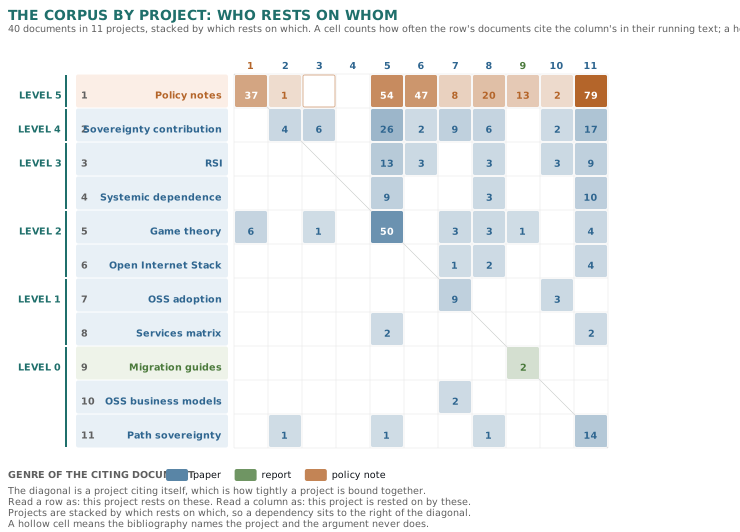
The ten projects. The diagonal is a project citing itself, which is how tightly a project is bound together. The policy notes rest on everything and nothing rests on them, which is what a policy note is for.
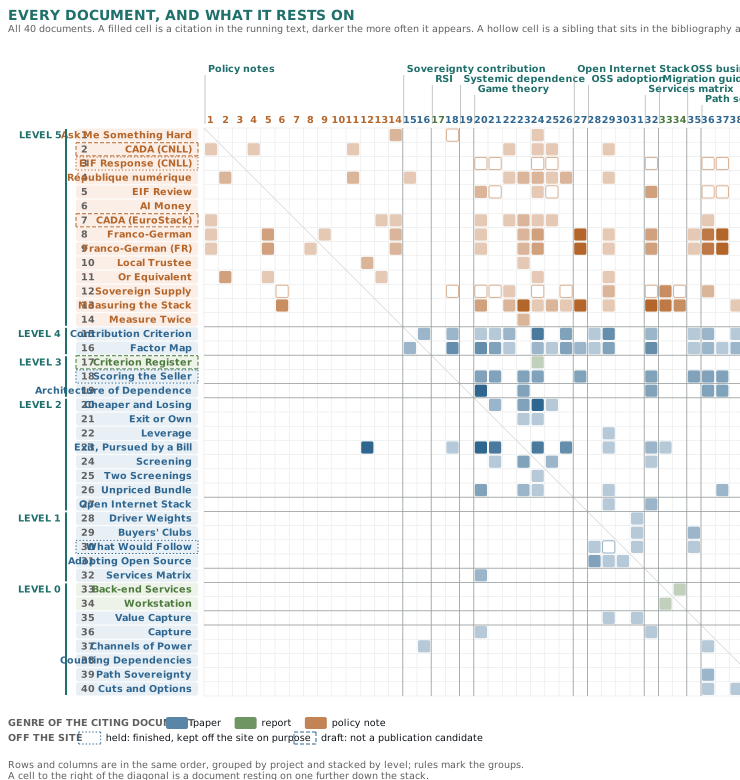
Every document and every dependency. The blocks on the diagonal are projects working on themselves; the dense rows near the bottom are the documents that synthesise across the programme. An empty row is a document that cites no sibling, which is where the corpus bottoms out.
The same graph is drawn as nodes and arrows on the corpus map, where a document can be pulled out of the tangle and read on its own.
Where to start
- Plain-language summaries: nineteen, one per paper, each linking to its full draft. No economics background needed.
- The interactive explorers: walk the measured graph of the European stack, or play the market and screening models live.
- The papers: nineteen draft working papers as PDFs.
- Methods and verification: how the numbers are produced, checked, and labeled.
Status
Every paper on this site is a draft working paper. None of it is peer-reviewed. The papers were prepared with AI assistance under a documented verification protocol; every quantitative claim traces to sourced data and reproducible computation, and claims are labeled measured, pipeline, or programme accordingly. Read the methods page before quoting any number.