The Open Source Workstation: A Migration Guide for Applications, the Desktop, and the Managed Linux Estate¶
Stefane Fermigier (Abilian) · sf@abilian.com
Draft working paper v0.11, 2026-09-28. Guide 2 of 2. The companion volume (Fermigier 2026a) covers directory, storage, mail, and real-time communication. Product statuses are stated as of the date given in §1.5; entries marked † were moving at that date and need re-checking before a procurement decision.
Abstract¶
This guide covers the end-user workstation: the applications on it, the operating system under them, and the machinery that manages both across an estate. It adapts a February 2024 Swiss federal study of client applications and two 2022 studies of the Linux desktop, one German and one French, from their public-administration setting to organisations generally.
It differs from the Swiss source in one structural respect. That study excluded the client operating system by design, stating that "Ein Umstieg auf Linux wird in dieser Studie explizit nicht angeschaut" [Standtke and Tiede 2024b]. This guide treats the Linux desktop as the destination and open-source applications on Windows or macOS as a transitional stage that is valuable on its own terms. The two stages are separable. The first is cheap and reversible; an organisation that stops after it has still removed real dependencies.
Three findings shape the advice. The Swiss study's own prioritisation method produces an ordering that inverts the usual migration plan: stateless single-purpose tools first, and the office suite and mail client last, because the format entanglement sits there. The German and French sources agree that the operating system should be the last thing to change, after every layer above it has already moved. The French field evidence, which is the only observational evidence in the corpus, finds the IT department's resistance stronger than the users'.
The management layer decides these projects. Applications reached parity for general office work years ago, with the exceptions §4.4, §4.5 and §16 name; §§7 to 15 cover provisioning, policy, packaging, inventory, client identity, encryption, printing, remote support, and hardware, where the actual work lies and which the sources treat thinly or not at all.
Keywords: open source software, Linux desktop, IT migration, fleet management, public procurement, total cost of ownership.
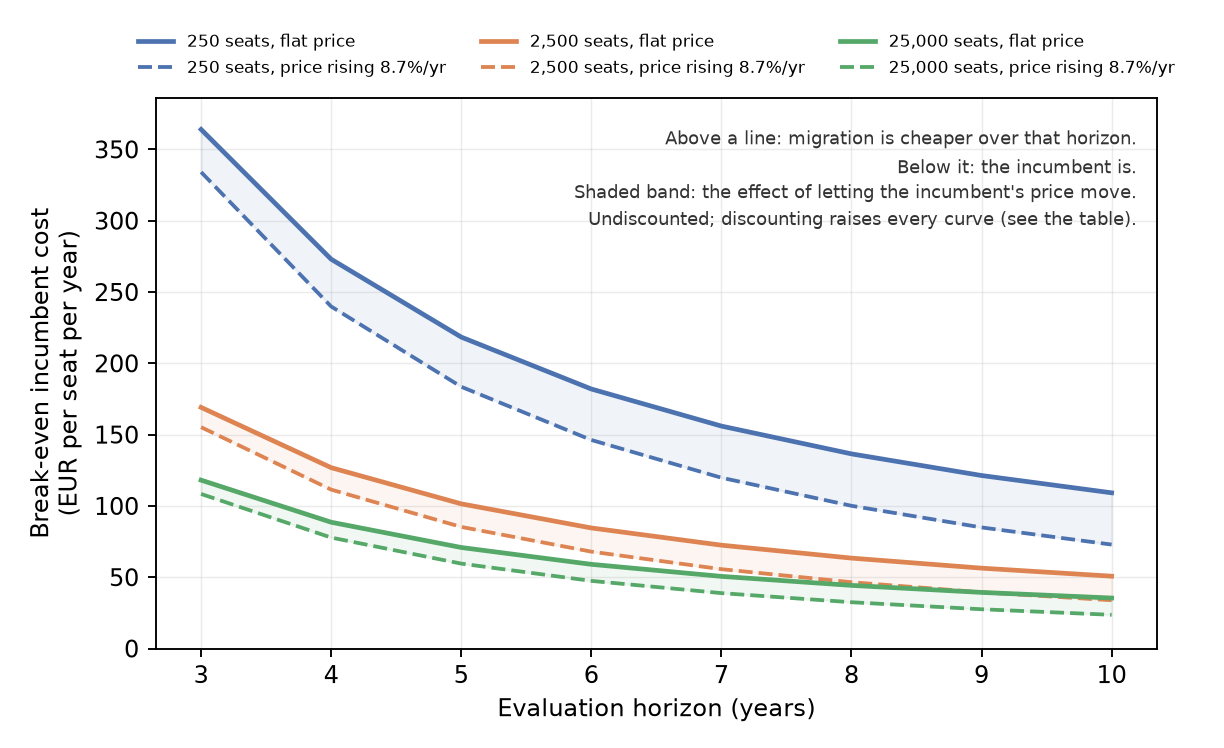
Break-even incumbent cost against the evaluation horizon for the workstation, for three estate profiles, with the incumbent's price flat or rising.
About this paper¶
| Programme | Migration guides |
| Genre | Report |
| Version | v0.11 |
| Date | 2026-09-28 |
| Full text | |
| Plain-language explainer | The office suite goes last |
Cite this paper¶
Fermigier, S. (2026). The Open Source Workstation: A Migration Guide for Applications, the Desktop, and the Managed Linux Estate.
Report v0.11, Abilian Econ Lab.
https://econ.lab.abilian.com/papers/workstation/