The Unpriced Bundle: Decision Suppression in Software Procurement
Stefane Fermigier (Abilian) · sf@abilian.com
Draft working paper v0.2, 2026-09-23. A short formal treatment: every proposition has a proof, a numeric cross-check, and a Monte-Carlo report. The record of Section 3 motivates the model and does not test it.
Abstract
An organisation does not replace a free component with a paid one, however much better the paid one is. The sentence is folklore among practitioners. The standard models of switching costs and network effects act on the terms of a decision; the economics of consumer inertia has models in which the decision itself must first occur, and has separated that inattention from switching costs empirically. This paper gives the mechanism an organisational carrier, the budget line, and draws its implications for remedies.
This paper models the occurrence. A component that arrives inside a bundled licence at zero incremental price generates no budget line, hence no renewal event, hence no comparison: the decision that the entrant's price would enter is never convened. In the model, procurement compares options only when a decision event fires; events are free at contract renewal for separately priced goods and require costly internal initiation for bundled ones.
Three results follow. Bundling loses the entrant two groups of buyers. Some would evaluate it and reject it, because dropping a component that has no price saves nothing: that is the zero-price effect the tying literature already prices. The others would adopt it if a decision were convened, and none is: an entrant worth its price is suppressed whenever the champion's stake falls short of the initiation cost (Proposition 1). On the calibrated illustration the second group is 40 of the 55 points of adoption that bundling removes. Conditional on non-initiation, adoption is invariant to the entrant's price: a subsidy buys nothing at a given buyer until it covers that buyer's full wedge gap, and part of what it then buys is the friction itself. What separates suppression from switching costs is timing: a suppressed buyer adopts when an event unrelated to price or to switching costs convenes the decision, while a buyer held by switching costs does not (Proposition 2). Instruments that re-create the decision event (line-itemised pricing, a periodic evaluation duty, disclosure of the imputed component price) restore the price margin for all buyers at once, at near-zero resource cost for a given component price (Proposition 3). The 2025 Microsoft Teams commitments, which require suites without the component at an appreciably lower price, with the corresponding offer displayed wherever the bundled one is advertised, are Proposition 3's instruments entering the record. Under imposed itemisation the incumbent sets the discount at the remedy's floor and, where it can, keeps the bundled suite as what renews; with that default the discount is a subsidy by another name, converting only the buyers whose wedge it covers, while a renewal without the component fires the event for all (Proposition 4). The size of the discount decides the remedy only where the default stays bundled.
Keywords: bundling, tying, procurement, status quo bias, switching costs, digital sovereignty, coordination.
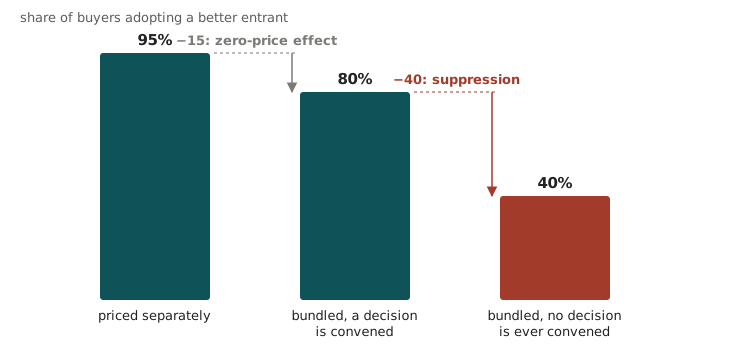
The calibrated illustration: bundling at zero price removes 55 points of adoption of a better entrant, 15 through the zero-price effect and 40 because the decision is never convened.
About this paper
| Programme | Game theory |
| Genre | Draft working paper |
| Version | v0.2 |
| Date | 2026-09-23 |
| Full text | |
| Plain-language explainer | The product with no budget line |
Cite this paper
Fermigier, S. (2026). The Unpriced Bundle: Decision Suppression in Software Procurement.
Draft working paper v0.2, Abilian Econ Lab.
https://econ.lab.abilian.com/papers/unpriced-bundle/