Screening for Sovereignty: Optimal Procurement when Compliance is Cheap to Fake and Costly to Verify
Stefane Fermigier (Abilian) · sf@abilian.com
Draft working paper v0.20, 2026-10-21. Theory; every closed-form claim has an appendix proof and an independent numeric cross-check. Section 6 shows the public record is consistent with the model; it does not test it against rival explanations.
Abstract
Public buyers increasingly attach sovereignty requirements to digital-infrastructure procurement: the supplier must be beyond the reach of foreign compulsion. We show that when a foreign-controlled supplier can meet requirements on data location and operational practice at the same cost as a sovereign one, those requirements cannot exclude it, at any price, penalty or audit intensity. Only verification of who effectively controls the supplier screens, once the accuracy clears a threshold we derive in closed form, which rises with what a mimic stands to win and falls with the cost of a shell company. We model such procurement as mechanism design with a hidden compliance action, a cheap cosmetic-compliance technology, and costly imperfect per-attribute audits backed by a bounded one-strike sanction. Because a detected fake forfeits the same stake however many attributes were faked, violations are complements. Per-attribute audit thresholds then do not implement compliance, and audit costs are superadditive across requirements: each requirement added to a tender raises the cost of making the others credible. The cost-minimizing audit is a cascade in which each attribute is audited against the stake net of its predecessors' temptations. The price both disciplines the incumbent, as a forfeitable bond, and subsidizes mimicry, by enlarging the prize a mimic keeps when verification fails. When the operational audit merely re-reads the evidence the control audit reads, a single audit is optimal. With a prior over supplier types, the buyer's problem has three regimes, screen, tolerate washing, or forgo the mandate: screening pays only when the probability of a mimic times the value of sovereignty covers the deterrence audit, so an accurate check can be feasible and not worth running, and a tolerated mimic is audited at the cap or not at all. When the shell must exist at the bid and mimics enter freely, washing becomes a probability set by the wedge and the shell cost, the accuracy threshold falls by the shell cost over the mimic's stake, and the buyer pays a higher price for the pool it faces. We characterize when sovereignty mandates do not repay their verification cost, and read the European cloud-procurement record through the results.
Keywords: procurement, costly state verification, multidimensional screening, auditing, digital sovereignty, compliance.
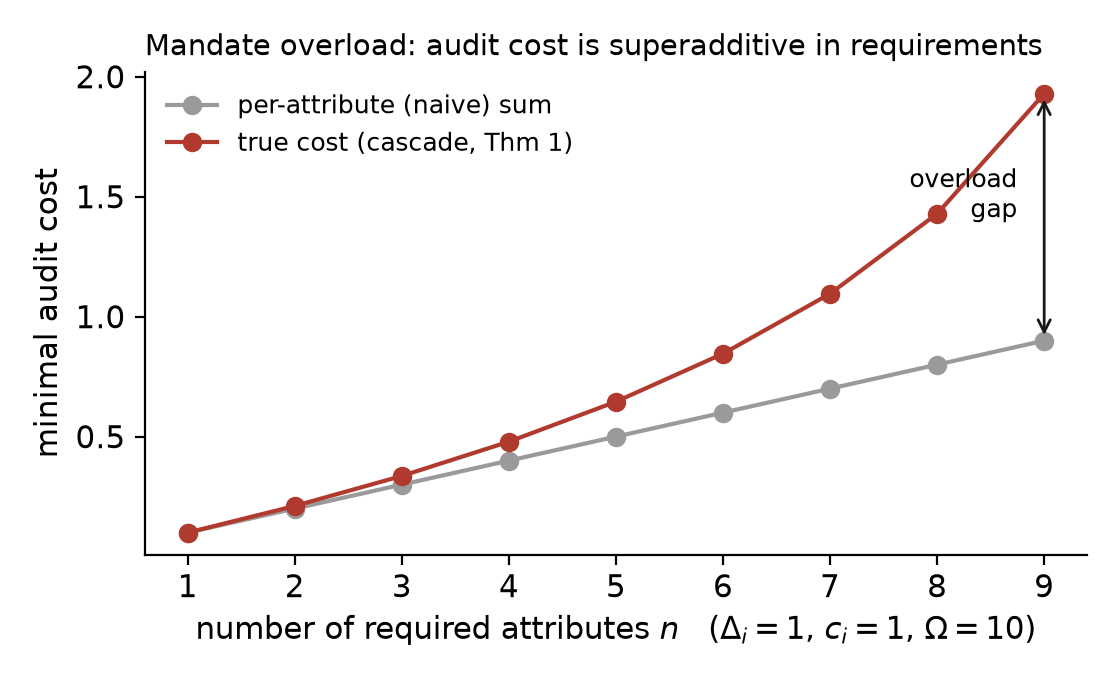
Mandate overload: the minimal audit cost of a credible mandate as the number of required attributes grows, against the naive per-attribute sum. The gap is the joint-deviation burden that per-attribute analysis omits.
About this paper
| Programme | Game theory |
| Genre | Draft working paper |
| Version | v0.20 |
| Date | 2026-10-21 |
| Full text | |
| Plain-language explainer | The subsidiary passes every audit |
Cite this paper
Fermigier, S. (2026). Screening for Sovereignty: Optimal Procurement when Compliance is Cheap to Fake and Costly to Verify.
Draft working paper v0.20, Abilian Econ Lab.
https://econ.lab.abilian.com/papers/screening-for-sovereignty/