Sovereignty as a Flow: Capture and the Durability of European Technology
Stefane Fermigier (Abilian) · sf@abilian.com
Draft working paper v0.7, 2026-09-23. Complete draft; causal identification and a blind re-coding of the outcome and lock variables remain open.
Abstract
European sovereignty instruments assess a firm's nationality at a point in time: at qualification, at award, at labeling. Control, we argue, is a flow. A European technology firm's control leaves European hands through four mechanisms (acquisition, private-equity buyout, an infrastructure deal that routes its stack onto foreign clouds, or a US listing and redomicile), so a "European tech" label is a snapshot of a liquid cap table.
We document this with a sourced registry of 24 completed captures, coded by a stated rule: 21 transfers of control (Nuxeo, Arm, DeepMind, Software AG, and others) and 3 sovereign-wrapper ventures, European-owned, that sell a foreign firm's product. The rule also records partial moves and pending cases. We then ask what resists capture. The universe is 125 technology firms prominent in Europe between 2005 and 2025, with outcomes recorded to September 2026, classified by ownership structure and outcome. On it, a formal governance lock (a foundation or steward-ownership, founder super-voting or loyalty shares, a golden share, or state control) is associated with survival as European in 81% of resolved cases, compared with 59% without. That is a capture rate of 19% compared with 41%, an odds ratio of 2.9 (95% interval 0.9 to 9.5). The association points the expected way under every recoding we tried, does not reach conventional significance on this sample, and is no smaller when firm size before the outcome is controlled (odds ratio 3.3, interval 0.97 to 11.1). A coding that also counted founder-owned private firms with founders who had declined to sell gives 89% compared with 55% (odds ratio 6.6), but that coding measures intent, which the outcome itself reveals. No formal lock in the universe was overridden; the one exercised against a hostile approach held (Ubisoft against Vivendi, 2015 to 2018). A lock does not stop a founder choosing a US listing for capital, nor insolvency. Some dispersed-ownership firms have stayed European at scale (SAP, Adyen, Amadeus), and large firms have been captured too (Arm, Autonomy, Supercell).
The policy implication is a reframing. A subsidy leaves a firm's ownership structure as it was, and among the prominent firms without a lock, 41% of resolved cases ended in capture. The record is consistent with durable European control resting on structure: a control lock, domestic capital deep enough to remove one reason firms list abroad, and a forkable commons for the rest.
Keywords: digital sovereignty, mergers and acquisitions, ownership structure, steward-ownership, industrial policy, technological autonomy.
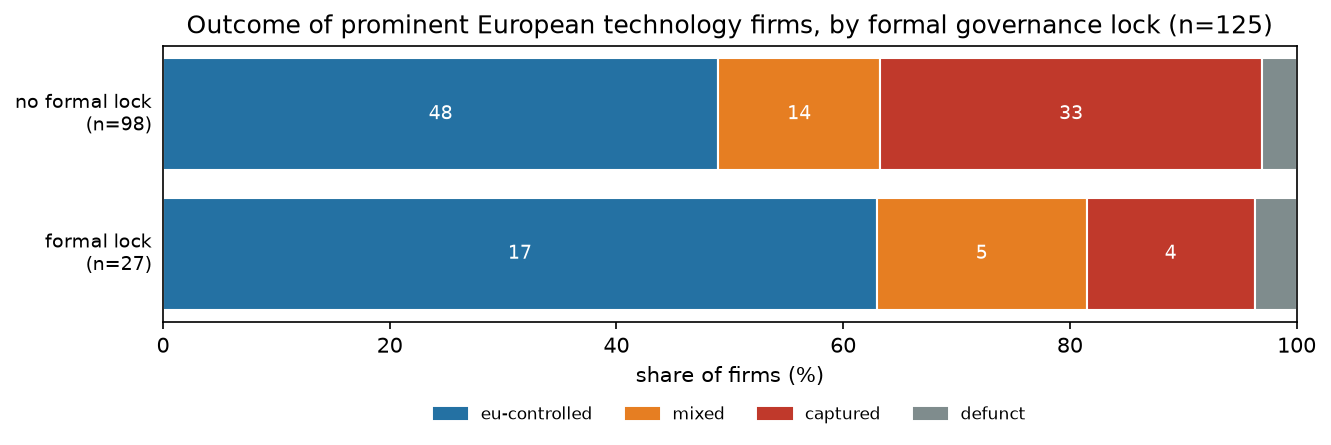
Outcome of 125 prominent European technology firms by formal governance lock: a lock shifts part of the mass from captured to European-controlled.
About this paper
| Programme | Path sovereignty |
| Genre | Draft working paper |
| Version | v0.7 |
| Date | 2026-09-23 |
| Full text | |
| Plain-language explainer | Losing the champions |
Cite this paper
Fermigier, S. (2026). Sovereignty as a Flow: Capture and the Durability of European Technology.
Draft working paper v0.7, Abilian Econ Lab.
https://econ.lab.abilian.com/papers/capture/