Building a Supplier-Side Sovereignty Index for the EuroStack Solution Finder
Stefane Fermigier (Abilian) · sf@abilian.com
Draft working paper v0.2, 2026-11-09. This paper specifies the index. The criterion basis, the rulebook, every coding of it and the analyses below are generated from repository data and recompute when a row is contested. An earlier version of the index is deployed in a public directory; Section 12 states where it departs from this one.
Abstract
The European Commission has awarded a public contract on a sovereignty score: it rated the bids for one of its own cloud tenders, worth up to EUR 180M over six years and awarded in April 2026, on eight sovereignty objectives. A Regulation before the Council and the Parliament would make a four-level assurance scale the condition of selling to any Union public body, and national and private frameworks multiply. A score of this kind has to settle three things: what it measures, which evidence it admits, and how it combines that evidence. The frameworks published by others state dimensions and weights without deriving either, count an answer the same whichever way it was obtained, and report a level without saying how much of the supplier they have established. This paper settles the three for the index of the EuroStack Solution Finder, before it scores any service.
This paper specifies a supplier-side index built from the question a buyer needs answered: when it obtains a digital service from a given supplier, how much of the decisions that matter about that service remain its own, or can be taken back? Six decisions define the dimensions: who can read or use the buyer's data, who can alter the service, who can stop it, who sets the terms, who decides what the service becomes, and who can maintain or replace it. A second family records what the service contributes to European capacity, beginning with the contribution share: the European value-added content of a euro the buyer pays, read through people, capital, inputs and returns. Autonomy on each dimension is a degree: retained, recoverable or ceded. A criterion is evidence about a degree; it enters the index when it is informative, checkable and hard to fake.
Four blind coders, AI agents on two models, classified the 94 distinct criteria of eighteen frameworks under a written rulebook. They agree substantially on the dimension and the channel and less on strength and durability. The rulebook has not been tested on criteria held out of its revision. Fifteen criteria are strong evidence under every coding. The channel a criterion is read through bounds what a reading can show: a pass on a supplier's declaration can shift the odds between two degrees by little, a pass on a registry extract or a test by much more. For a reader who scores each reading on its own, a supplier that holds an attribute gains from the more informative channel and one that does not gains from the less informative one, so the channel a supplier chooses is itself evidence. Readings combine by their likelihoods into a degree on each dimension, with its confidence and the coverage behind it.
Consequences for the scoring follow. The fifteen strong criteria are the core of what the index collects, while criteria that are evidence on no dimension, about three tenths of the weight in the Commission's assessment, are collected and displayed and never scored. Each question requests evidence through the strongest channel that reaches it, since a declaration without other evidence barely moves the estimate. No question aimed at who can alter the service is strong evidence under every coding, and on who decides what it becomes only the veto rights in the ownership chain are. Those questions have to be written, and the rulebook has yet to grade existing criteria on the other dimensions they bear on. Suppliers need a route to correct the record, since a registry that wrongly fails a supplier misreports it by name. The result is a profile, one degree per dimension shown as a radar; a dimension shows a degree, or a bound such as at least recoverable, only once the evidence makes it more than 80 percent likely. Composite figures for kinds of buyer state their weights and appear only where evidence beyond the supplier's word establishes a degree or a bound on every dimension they weight. The index builds in no gate: a buyer who wants a minimum on one dimension sets it. A service whose evidence there is missing or inconclusive is then reported as not established. The classification predicts how often services at each degree meet each criterion, which a review of twenty services is designed to test. The sharpest limit is node scope: a good score for one supplier is consistent with a captured stack.
Keywords: sovereignty, strategic autonomy, procurement, composite indicators, aggregation, verification.
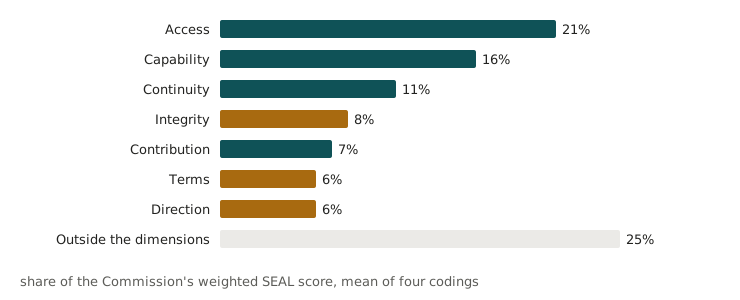
Where the Commission's sovereignty assessment puts its weight, by the decision each question bears on: access leads, while integrity, terms and direction (amber) are thin and a quarter bears on no decision about the service.
About this paper
| Programme | Supplier-side index |
| Genre | Draft working paper |
| Version | v0.2 |
| Date | 2026-11-09 |
| Full text |
Cite this paper
Fermigier, S. (2026). Building a Supplier-Side Sovereignty Index for the EuroStack Solution Finder.
Draft working paper v0.2, Abilian Econ Lab.
https://econ.lab.abilian.com/papers/building-a-supplier-side-index/