The Architecture of Dependence: Control Points, Value Capture and Capability in the Digital Stack
Stefane Fermigier (Abilian) · sf@abilian.com
Draft working paper v0.3, 2026-10-08. Measurement and theory. The rents are measured on the capital the UK competition authority counts, from company filings and competition authorities' findings, with their range under other definitions of capital and over five fiscal years in Appendix C; the edges of spreading control are checked against a census of the annual filings. The propositions have proofs in Appendix A and numeric cross-checks in the reproduction scripts. Proposition 7 is proved for linear demand and for two holders under any demand; for three holders under other demand shapes, it rests on a Monte-Carlo check.
Abstract
European organisations buy their digital technology through a stack of complementary layers, from chips to cloud, software, AI models and payment rails. This paper maps the stack's control points, positions many others depend on, costly to substitute and held by few: 39 positions from rated public sources, 27 of them control points, and 66 edges checked against 88 annual filings. It measures the rent each control point earns, the share of income above the cost of capital on the UK competition authority's definition of capital: 48 cents of each euro at the leading accelerator maker, 25 at Microsoft's productivity suite, 22 at the leading foundry, 6 to 11 in cloud infrastructure and 32 to 39 at the card schemes. The median control point earns 11 cents against 2 where several suppliers compete, under every coding of the map. The holders of lower control points earn their margin on what the positions above them buy, so backing runs up the stack against the payments: 12 of 17 documented financings run along a payment path back to the backer, where 2.5 percent of pairs of positions have one. Opening a control point lowers buyers' prices and raises the remaining holders' rents. Europe's four control points earn 0 to 15 cents per euro, largely from outside Europe, spend more on research than they earn in rent, and anchor no industry above them. Cloud is the worked example: its rent on European revenue was at least EUR 3.1 billion in 2024.
Keywords: control points, value capture, economic rent, complementary monopoly, vertical chains, platform envelopment, cloud computing, digital sovereignty.
JEL: L13, L14, L22, L42, L86, F12, F23.
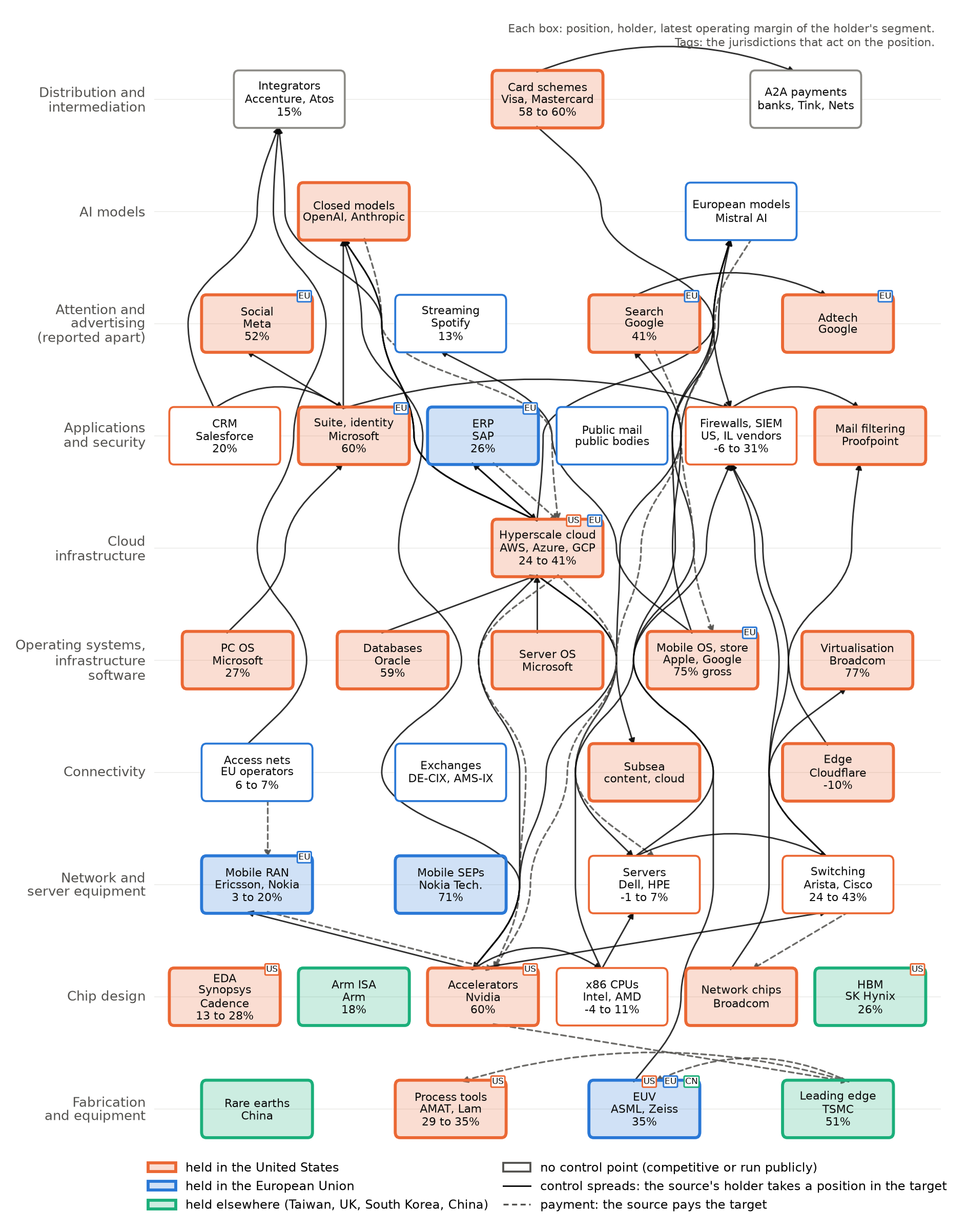
The architecture map: the control points of each layer, tinted by the holder's home, with the edges along which a holder takes a position in another layer (solid) and the payments between them (dashed).
About this paper
| Programme | Systemic dependence |
| Genre | Draft working paper |
| Version | v0.3 |
| Date | 2026-10-08 |
| Full text |
Cite this paper
Fermigier, S. (2026). The Architecture of Dependence: Control Points, Value Capture and Capability in the Digital Stack.
Draft working paper v0.3, Abilian Econ Lab.
https://econ.lab.abilian.com/papers/architecture/