A Two-Dimensional Taxonomy of Cloud Service Integrations: Modeling Architectural Coupling and Portability Friction in Managed Infrastructures
Stefane Fermigier (Abilian) · sf@abilian.com
Draft working paper v1.2, 2026-09-23. Thirty-five AWS services, single-coder scores with a blinded AI reproducibility check, the robustness suite passing; Azure and GCP replication, external expert coding, and per-service anchoring queued.
Abstract
Modern software engineering increasingly relies on managed cloud services to accelerate delivery and reduce operational overhead. However, the adoption of these services introduces varying degrees of architectural coupling and vendor lock-in. This paper presents a formal, two-dimensional taxonomic framework to classify cloud services along two orthogonal axes: Architectural Coupling ($\mathcal{C}{arch}$) and Exit Friction ($\mathcal{F}$). By evaluating core Amazon Web Services (AWS) offerings through this systematic model, we transition cloud selection from a heuristic-based practice to a quantifiable software engineering discipline. This taxonomy enables system architects to mathematically assess the long-term structural risks and migration overhead associated with cloud-native system designs. We then extend the model to the question of European digital sovereignty: using Donella Meadows' twelve leverage points, we rank the interventions that could most efficiently move EU governments and enterprises off US hyperscalers, and we derive several economic consequences, including a lock-in floor: wherever the interface term outweighs data gravity, which is the case for every deeply locked service, policy acting on data transport alone reaches less than half of a service's scored exit friction at any weight below one half; under the calibrated weight it reaches about a fifth on average, and under 30 percent on the deeply locked services where the policy problem lies. A further consequence is the identification of architectural lock-in as a negative externality that justifies disclosure-and-standards intervention over subsidy.
Keywords: cloud computing, vendor lock-in, switching costs, portability, architectural coupling, data gravity, EU Data Act.
JEL: L86, L15, L13, D62, L51, F52.
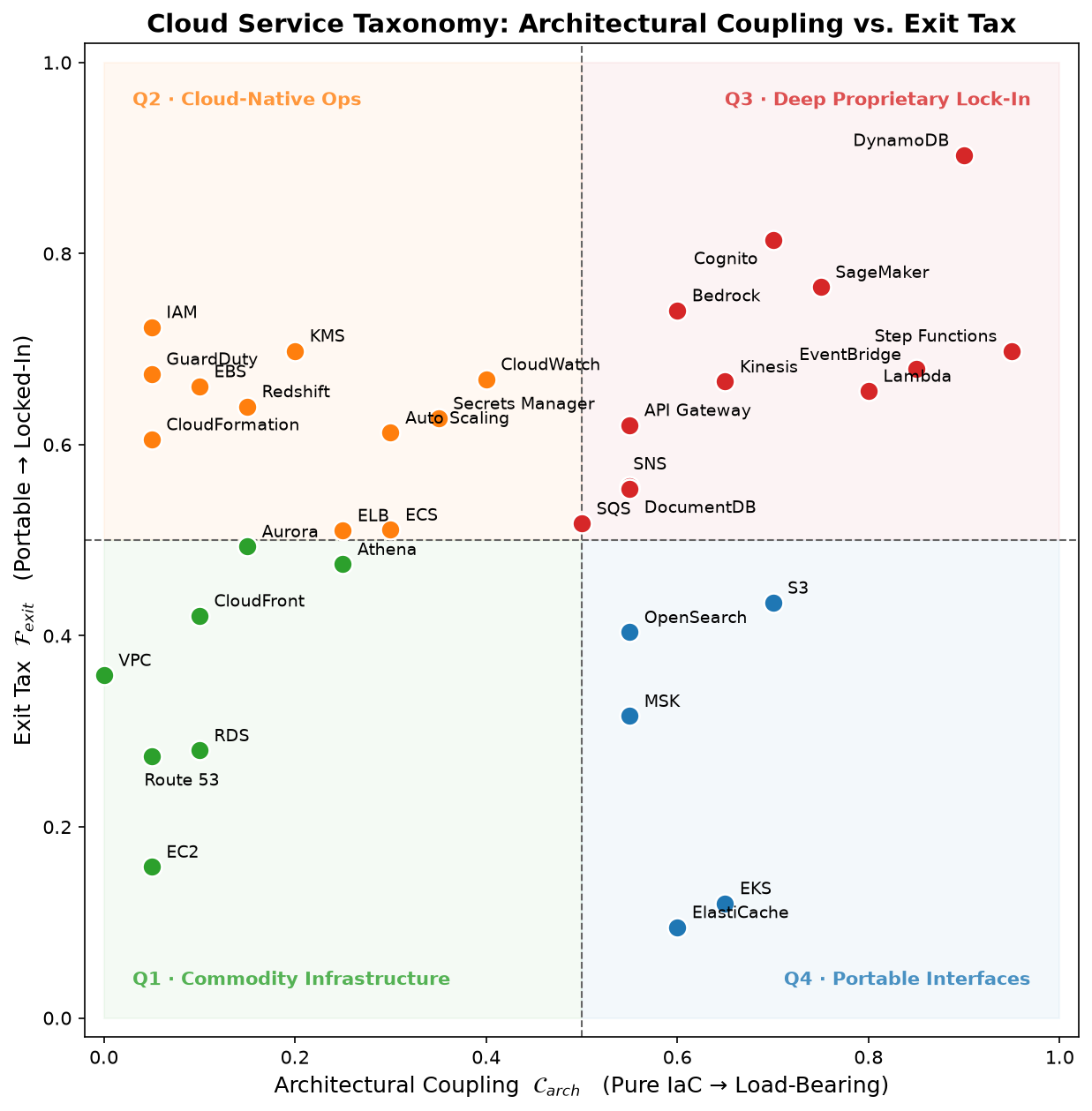
Thirty-five managed cloud services plotted by architectural coupling and exit friction, coloured by quadrant.
About this paper
| Programme | Cloud architecture |
| Genre | Draft working paper |
| Version | v1.2 |
| Date | 2026-09-23 |
| Full text | |
| Plain-language explainer | How locked in are you, exactly? |
Cite this paper
Fermigier, S. (2026). A Two-Dimensional Taxonomy of Cloud Service Integrations: Modeling Architectural Coupling and Portability Friction in Managed Infrastructures.
Draft working paper v1.2, Abilian Econ Lab.
https://econ.lab.abilian.com/papers/cloud-services-matrix/